How Had Powers Again Austra Hungary
The dissolution of Austria-Hungary was a major geopolitical outcome that occurred as a consequence of the growth of internal social contradictions and the separation of different parts of Austria-Hungary. The reason for the collapse of the country was World State of war I, the 1918 crop failure and the economic crisis.[ citation needed ] The 1917 October Revolution and the Wilsonian peace pronouncements from January 1918 onward encouraged socialism on the one hand, and nationalism on the other, or alternatively a combination of both tendencies, among all peoples of the Habsburg monarchy.[1]
The remaining territories inhabited by divided peoples fell into the limerick of existing or newly formed states. Legally, the collapse of the empire was formalized in the Treaty of Saint-Germain-en-Laye with Austria, which also acted equally a peace treaty after the First World War, and in the Treaty of Trianon with Republic of hungary.
Process [edit]
Demise [edit]
By 1918, the economic situation had deteriorated. Leftist and pacifist political movements organized strikes in factories, and uprisings in the army had become commonplace. At the last Italian offensive, the Austro-Hungarian Army took to the field without whatever food and munition supply and fought without any political supports for a de facto not-existent empire. On the stop of the decisive joint Italian, British and French offensive at Vittorio Veneto, the disintegrated Austria–Hungary signed the Armistice of Villa Giusti on 3 November 1918.
The government had failed desperately on the homefront. Historian Alexander Watson reports:
across central Europe ... The majority lived in a state of advanced misery by the spring of 1918, and atmospheric condition after worsened, for the summer of 1918 saw both the driblet in food supplied to the levels of the 'turnip winter', and the onset of the 1918 flu pandemic that killed at least 20 million worldwide. Club was relieved, exhausted and yearned for peace.[2]
The Austro-Hungarian Monarchy collapsed with dramatic speed in the fall of 1918. In the majuscule cities of Vienna and Budapest, the leftist and liberal movements and politicians (the opposition parties) strengthened and supported the separatism of ethnic minorities. These leftist or left-liberal pro-Entente bohemian parties opposed the monarchy as a class of government and considered themselves internationalist rather than patriotic. Eventually, the German defeat and the small revolutions in Vienna and Budapest gave political power to the left/liberal political parties.
Disintegration [edit]
As it became credible that the Allied powers would win Earth State of war I, nationalist movements, which had previously been calling for a greater degree of autonomy for various areas, started pressing for full independence. The Emperor had lost much of his ability to rule, as his realm disintegrated.[3]
Equally one of his Fourteen Points, President Woodrow Wilson demanded that the nationalities of Austria–Hungary have the "freest opportunity to democratic development". In response, Emperor Karl I agreed to reconvene the Majestic Parliament in 1917 and allow the creation of a confederation with each national group exercising self-governance. Still, the leaders of these national groups rejected the idea; they securely distrusted Vienna and were at present determined to go independence.

The revolt of ethnic Czech units in Austria in May 1918 was brutally suppressed. It was considered a wildcat by the lawmaking of war machine justice.
On 14 October 1918, Foreign Minister Baron István Burián von Rajecz[4] asked for an armistice based on the Fourteen Points. In an apparent attempt to demonstrate skillful faith, Emperor Karl issued a annunciation ("Purple Manifesto of 16 Oct 1918") two days afterwards which would have significantly contradistinct the structure of the Austrian half of the monarchy. The Polish majority regions of Lesser Poland and part of Galicia were to be granted the selection of seceding from the empire to join the earlier established Smoothen proto-state, in order to reunite with their indigenous brethren in the Shine lands held by Russian federation and Germany, with the ultimate goal of resurrecting the sovereign Polish statehood. Yet, the majestic authorities attempted to curb the Smoothen ambitions past inciting the Polish-Ukrainian conflict through separating and retaining the residue of Galicia and the entire Lodomeria, designated in the secret Treaty of Brest-Litovsk (Ukraine–Central Powers) for the purpose of creating a Ukrainian polity, intended in the proclamation to institute along the balance of Cisleithania a transformed federal union equanimous of four parts—German, Czech, South Slav and Ukrainian. Each of these was to be governed by a national council that would negotiate the future of the empire with Vienna. Trieste was to receive a special status. No such annunciation could be issued in Hungary, where Hungarian aristocrats still believed they could subdue other nationalities and maintain the "Holy Kingdom of St. Stephen".
It was a dead letter. Iv days subsequently, on 18 October, United States Secretarial assistant of State Robert Lansing replied that the Allies were now committed to the causes of the Czechs, Slovaks and South Slavs. Therefore, Lansing said, autonomy for the nationalities – the tenth of the Fourteen Points – was no longer enough and Washington could not bargain on the basis of the Fourteen Points anymore. In fact, a Czechoslovak provisional government had joined the Allies on 14 October. The Southward Slavs in both halves of the monarchy had already alleged in favor of uniting with Serbia in a large South Slav country by style of the 1917 Corfu Annunciation signed past members of the Yugoslav Committee. Indeed, the Croatians had begun disregarding orders from Budapest earlier in October. The Lansing note was, in issue, the death certificate of Austria–Republic of hungary.
The national councils had already begun acting more than or less as provisional governments of independent countries. During the Italian battles, the Czechoslovaks and Southern Slavs alleged their independence. With defeat in the war imminent afterward the Italian offensive in the Battle of Vittorio Veneto on 24 Oct, Czech politicians peacefully took over control in Prague on 28 October (afterward alleged the altogether of Czechoslovakia) and followed up in other major cities in the next few days. On 30 October, the Slovaks followed in Martin. On 29 October, the Slavs in both portions of what remained of Republic of austria–Republic of hungary proclaimed the Land of Slovenes, Croats and Serbs. They as well declared that their ultimate intention was to unite with Serbia and Montenegro in a large South Slav land. On the same day, the Czechs and Slovaks formally proclaimed the establishment of Czechoslovakia equally an independent state.
Dissolution [edit]
Alexander Watson argues that, "The Habsburg authorities's doom was sealed when Wilson's response to the note, sent two and a half weeks earlier [by the strange minister Baron István Burián von Rajecz on 14 Oct 1918 [four]], arrived on 20 October." Wilson rejected the continuation of the dual monarchy equally a negotiable possibility.[five]
On 17 Oct 1918, the Hungarian Parliament voted in favour of terminating the spousal relationship with Austria and declared the independence of the land. The most prominent opponent of continued union with Republic of austria, Count Mihály Károlyi, seized power in the Aster Revolution on 31 October. Charles was all but forced to appoint Károlyi as his Hungarian prime government minister. One of Károlyi's first acts was to cancel the compromise agreement, officially dissolving the Austro-Hungarian state. On 31 October Republic of hungary ended the personal union with Austria, officially dissolving the Monarchy.
By the end of October, there was aught left of the Habsburg realm but its majority-German Danubian and Alpine provinces, and Karl's authorisation was being challenged even in that location past the German-Austrian state council.[half dozen] Karl's last Austrian prime number minister, Heinrich Lammasch, concluded that Karl was in an incommunicable state of affairs, and persuaded Karl that the best course was to relinquish, at least temporarily, his right to exercise sovereign authority.
On eleven Nov, Karl issued a advisedly worded proclamation in which he recognized the Austrian people'south correct to determine the form of the country.[7] He as well renounced the right to participate in Austrian affairs of state. He too dismissed Lammasch and his government from office and released the officials in the Austrian half of the empire from their oath of loyalty to him. Two days later, he issued a similar proclamation for Hungary. Still, he did not abdicate, remaining available in the event the people of either country should recall him. For all intents and purposes, this was the end of Habsburg rule.
Karl'due south I proclamation[8]
| Since my ascension to the throne, I have been constantly trying to lead my people out of the horrors of war, which I am not responsible for. I take not hesitated to restore constitutional life and have opened the way for peoples to develop their own country independently. Withal filled with unchangeable love for all My peoples, I practice not desire to oppose the free development of My Person every bit an obstacle. I recognize in accelerate the decision that German Austria will make regarding its time to come form of regime. The people took over the government through their representatives. I waive any share in state affairs. At the same time, I am releasing My Austrian Government from office. May the people of German Republic of austria create and consolidate the reorganization in harmony and forgiveness. The happiness of my peoples has been the goal of my hottest wishes from the beginning. Only inner peace tin can heal the wounds of this war. | Seit meiner thronbesteigung war ich unablässig bemüht, Meine Volker aus den Schrecknissen des Krieges herauszuführen, an dessen Ausbruch ich keinerlei Schuld trage. Ich habe nicht gezögert, das verfassungsmaßige Leben wieder herzustellen und haben den Völkern den Weg zu ihrer selbständingen staatlichen Entwicklung eröffnet. Nach wie vor von unwandelbarer Liebe für alle Meine Völker erfüllt, will ich ihrer freien Entfaltung Meine Person nicht als Hindernis entgegenstellen. Im voraus erkenne ich dice Entscheidung an, die Deutschösterreich über seine künftige Staatsform trifft. Das Volk hat durch seine Vertreter die Regierung übernommen. Ich verzichte auf jeden Anteil an den Staatsgeschäften. Gleichzeitig enthebe ich Meine österreichische Regierung ihres Amtes. Möge das Volk von Deutschösterreich in Eintracht und Versöhnlichkeit dice Neuordnung schaffen und befestigen. Das Glück Meiner Völker state of war von Anbeginn das Ziel Meiner heißesten Wünsche. Nur der innere Friede kann die Wunden dieses Krieges heilen. |
Karl'southward refusal to abdicate was ultimately irrelevant. On the 24-hour interval subsequently he announced his withdrawal from Republic of austria's politics, the German-Austrian National Council proclaimed the Republic of German Austria. Károlyi followed suit on 16 November, proclaiming the Hungarian Democratic Democracy.
Aftermath [edit]
Successor states [edit]

The Treaty of Trianon: Kingdom of Hungary lost 72% of its state and 3.iii 1000000 people of Hungarian ethnicity.
There were two legal successor states of the former Austro–Hungarian monarchy:[nine]
- High german Austria (which became the Kickoff Austrian Democracy)
- Hungarian Autonomous Republic (which after a few other short-lived intermediaries became the Kingdom of Hungary)
The Treaty of Saint-Germain-en-Laye (between the victors of Earth War I and Austria) and the Treaty of Trianon (between the victors and Hungary) regulated the new borders of Austria and Hungary, reducing them to small-sized and landlocked states. In regard to areas without a decisive national majority, the Entente powers ruled in mamy cases in favour of the newly-emancipated independent nation-states, enabling them to claim vast territories containing sizeable High german- and Hungarian-speaking populations.
The decisions independent in the treaties had immense political and economic effects. The previously rapid economic growth of the regal territories initially stalled because the new borders became major economical barriers. Many established industries and infrastructure elements were intended to satisfy the needs of an all-encompassing realm. Every bit a effect, the emerging countries were ofttimes compelled to considerable sacrifices in order to transform their economies. A major political unease in the affected regions followed as a outcome of these economic difficulties, fueling in some cases extremist movements.
Austria [edit]
Equally a result, the Republic of Republic of austria lost roughly 60% of the old Austrian Empire'south territory. It besides had to drop its plans for union with Federal republic of germany, every bit it was not immune to unite with Federal republic of germany without League approval.
The new Austrian state was, at to the lowest degree on paper, on shakier ground than Hungary. Unlike its former Hungarian partner, Austria had never been a nation in any real sense. While the Austrian state had existed in 1 grade or some other for 700 years, it was united merely past loyalty to the Habsburgs. With the loss of 60% of the Austrian Empire's prewar territory, Vienna was now a lavish and oversized imperial capital lacking an empire to support it, thus being sarcastically referred to as the "national hydrocephalus".
However, after a brief period of upheaval and the Allies' foreclosure of union with Frg, Austria established itself as a federal commonwealth. Despite the temporary Anschluss with Nazi Germany, it still survives today. Adolf Hitler cited that all "Germans" – such as him and the others from Austria, etc. – should be united with Germany.
Hungary [edit]
By comparison, Hungary had been a nation and a state for over 900 years. Hungary, however, was severely disrupted past the loss of 72% of its territory, 64% of its population and most of its natural resource. The Hungarian Democratic Commonwealth was short-lived and was temporarily replaced by the communist Hungarian Soviet Democracy. Romanian troops ousted Béla Kun and his communist regime during the Hungarian–Romanian War of 1919.
In the summer of 1919, a Habsburg, Archduke Joseph August, became regent, just was forced to stand down later on only two weeks when it became credible the Allies would not recognise him.[10] Finally, in March 1920, royal powers were entrusted to a regent, Miklós Horthy, who had been the final commanding admiral of the Austro-Hungarian Navy and had helped organize the counter-revolutionary forces. It was this government that signed the Treaty of Trianon under protest on four June 1920 at the Thousand Trianon Palace in Versailles, France. The restored Kingdom of Hungary lost roughly 72% of the pre-war territory of the Kingdom of Hungary. [eleven] [12]
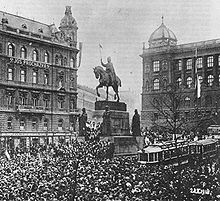
Habsburg adjournment [edit]
Austria had passed the "Habsburg Police force," which both dethroned the Habsburgs and banished all Habsburgs from Austrian territory. While Karl was banned from always returning to Austria once again, other Habsburgs could return if they gave upwardly all claims to the defunct throne.
In March and once more in Oct 1921, sick-prepared attempts by Karl to regain the throne in Budapest collapsed. The initially wavering Horthy, afterwards receiving threats of intervention from the Allied Powers and the Little Entente, refused his cooperation. Before long subsequently, the Hungarian government nullified the Pragmatic Sanction, effectively dethroning the Habsburgs. Later, the British took custody of Karl and removed him and his family unit to the Portuguese island of Madeira, where he died the following year.
Territorial legacy [edit]
Immediately after Earth State of war I [edit]
The following states were formed, re-established or expanded at the dissolution of the former Austro–Hungarian monarchy:[nine]
- German Austria (which became the Get-go Austrian Republic)
- Get-go Hungarian Commonwealth which became the Hungarian Soviet Commonwealth, subsequently briefly restored and replaced by the Hungarian Democracy, ultimately transformed into the Kingdom of Republic of hungary
- Outset Czechoslovak Republic ("Czechoslovakia" from 1920 to 1938)
- Second Polish Republic, contested by the curt-lived proto-states of Tarnobrzeg Republic and Polish Soviet Socialist Democracy
- Country of Slovenes, Croats and Serbs and the Kingdom of Serbia, both later absorbed into the Kingdom of Serbs, Croats and Slovenes
- Greater Romania
- Kingdom of Italy
- the brusk-lived Ukrainian and Rusyn proto-states of Westward Ukrainian People'south Republic (after captivated into Ukrainian People'due south Democracy), Hutsul Republic, Lemko Republic, Komancza Republic and the Galician Soviet Socialist Republic; all were ultimately captivated mostly into Poland, just also into Hungary, Czechoslovakia and Romania
The Principality of Principality of liechtenstein, which had formerly looked to Vienna for protection, formed a customs and defense union with Switzerland, and adopted the Swiss currency instead of the Austrian. In Apr 1919, Vorarlberg – the westernmost province of Austria – voted by a large bulk to join Switzerland; still, both the Swiss and the Allies disregarded this outcome.
Present [edit]
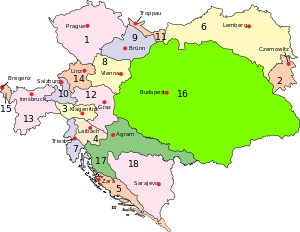 Kingdoms and countries of Austria-hungary: Cisleithania (Empire of Republic of austria[xiii]): i. Bohemia, 2. Bukovina, 3. Carinthia, four. Carniola, 5. Dalmatia, half-dozen. Galicia, 7. Küstenland, eight. Lower Republic of austria, nine. Moravia, ten. Salzburg, 11. Silesia, 12. Styria, 13. Tyrol, fourteen. Upper Austria, fifteen. Vorarlberg; Transleithania (Kingdom of Republic of hungary[xiii]): 16. Hungary proper 17. Croatia-Slavonia; 18. Bosnia and Herzegovina (Austro-Hungarian condominium) |
The following nowadays-day countries and parts of countries were inside the boundaries of Austria-Hungary when the empire was dissolved:
Empire of Austria (Cisleithania):
- Austria (except Burgenland)
- Czech Commonwealth (except the Hlučínsko area)
- Slovenia (except Prekmurje)
- Italian republic (Trentino, Southward Tyrol, parts of the province of Belluno and modest portions of Friuli-Venezia Giulia)
- Croatia (Dalmatia, Istria)
- Poland (voivodeships of Lesser Poland, Subcarpathia, southernmost function of Silesia (Bielsko and Cieszyn))
- Ukraine (oblasts of Lviv, Ivano-Frankivsk, Ternopil (except its northern corner) and near of the oblast of Chernivtsi)
- Romania (county of Suceava)
- Montenegro (bay of Boka Kotorska, the coast and the firsthand hinterland effectually the cities of Budva, Petrovac and Sutomore)
Kingdom of Hungary (Transleithania):
- Hungary;
- Slovakia
- Austria (Burgenland)
- Slovenia (Prekmurje)
- Croatia (Croatian Baranja and Međimurje county, Fiume as corpus separatum forth with Slavonia and Central Republic of croatia were not office of Hungary proper, the latter ii were part of the sovereign Kingdom of Croatia-Slavonia)
- Ukraine (oblast of Zakarpattia)
- Romania (region of Transylvania, Partium and parts of Banat, Crișana, and Maramureș)
- Serbia (democratic province of Vojvodina and northern Belgrade region)
- Poland (Smooth parts of Orava and Spiš)
Austro-Hungarian Condominium
- Republic of bosnia and herzegovina (the villages of Zavalje, Mali Skočaj and Veliki Skočaj including the immediate surrounding surface area west of the city of Bihać)
- Montenegro (Sutorina – western function of the Municipality of Herceg Novi between present borders with Republic of croatia (SW) and Bosnia and herzegovina (NW), Adriatic coast (Due east) and the township of Igalo (NE))
- Sandžak-Raška region, Austro-Hungarian occupied 1878 until withdrawal in 1908 whilst formally part of the Ottoman Empire
- The Empire treated Bosnia-Herzegovina in much the same way the other powers treated their overseas colonies[14]
Other possessions of the Austro-Hungarian Monarchy
- The Empire decided non to attempt any overseas colonies.[fifteen]
- Its only possession outside of Europe was its pocket-size concession inside the urban center of Tianjin, Cathay. It was granted in return for supporting the Eight-Nation Alliance in suppressing the Boxer Rebellion. Nonetheless although the zone was but an Austro-Hungarian possession for 16 years, the Austro-Hungarians left their marker on that area of the city, in the class of architecture that still stands in the urban center.[16]
Another provinces of Europe had been part of the Habsburg monarchy at in one case before 1867. Prominent examples are the regions of Lombardy and Veneto in Italy, Silesia in Poland, nigh of Kingdom of belgium and Serbia, and parts of northern Switzerland and southwestern Germany.
Literature [edit]
- Cornwall, Mark, ed. The Final Years of Austria-hungary University of Exeter Printing, 2002. ISBN 0-85989-563-7
References [edit]
- ^ "The collapse of Austria-Hungary". Encyclopædia Britannica.
- ^ Alexander Watson, Ring of Steel: Deutschland and Republic of austria–Republic of hungary in World War I (2014), p 536
- ^ Watson, Ring of Steel pp 536–40
- ^ a b "Hungarian foreign ministers from 1848 to our days". Mfa.gov.hu. Archived from the original on 21 June 2006. Retrieved 28 August 2016.
- ^ Watson, Ring of Steel pp. 541–two
- ^ Watson, Ring of Steel pp 542–56
- ^ The 1918 Karl's proclamation. British Library.
- ^ The Karl's I proclamation. British Library.
- ^ a b Stangl, Andrea. "The successor states to the Austro-Hungarian Monarchy". habsburger.net . Retrieved 3 March 2021.
- ^ "Dice amtliche Meldung über den Rücktritt" (in German). Neue Freie Presse, Morgenblatt. 24 August 1919. p. 2. Archived from the original on 26 December 2015. Retrieved 2 June 2017.
- ^ "Trianon, Treaty of". The Columbia Encyclopedia. 2012. Archived from the original on 28 December 2008. Retrieved 28 August 2016.
- ^ Tucker, Spencer; Priscilla Mary Roberts (2005). Encyclopedia of World War I (1 ed.). ABC-CLIO. p. 1183. ISBN978-one-85109-420-two.
Virtually the entire population of what remained of Hungary regarded the Treaty of Trianon as plain unfair, and agitation for revision began immediately.
- ^ a b Headlam, James Wycliffe (1911). . In Chisholm, Hugh (ed.). Encyclopædia Britannica. Vol. three (11th ed.). Cambridge University Press. pp. 2–39.
- ^ Samuel R. Williamson, Austro-hungarian empire and the origins of the Outset World State of war (Macmillan International College Education, 1990), states, "Through the occupation Austria-Hungary became a colonial ability." p. 63.
- ^ Samuel R. Williamson, Republic of austria-Hungary and the origins of the First Earth War (Macmillan International Higher Education, 1990), states, "Through the occupation Austria-hungary became a colonial power." p. 63.
- ^ For more information well-nigh the Austro-Hungarian concession, run into: Concessions in Tianjin#Austro-Hungarian concession (1901–1917).
Source: https://en.wikipedia.org/wiki/Dissolution_of_Austria-Hungary
0 Response to "How Had Powers Again Austra Hungary"
Postar um comentário