Type of 2d Art That Is Based on Fantasy and the Supernatural
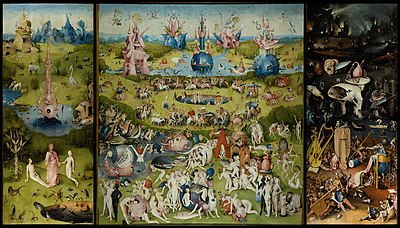
Fantastic art is a broad and loosely defined art genre.[one] It is non restricted to a specific school of artists, geographical location or historical period. It can exist characterised past bailiwick matter – which portrays non-realistic, mystical, mythical or folkloric subjects or events – and style, which is representational and naturalistic, rather than abstract – or in the case of magazine illustrations and like, in the style of graphic novel fine art such every bit manga.
Fantasy has been an integral part of art since its beginnings,[2] but has been especially important in mannerism, magic realist painting, romantic art, symbolism, surrealism and lowbrow. In French, the genre is chosen le fantastique, in English language it is sometimes referred to as visionary art, grotesque art or mannerist fine art. Information technology has had a deep and circular interaction with fantasy literature.
The subject matter of fantastic art may resemble the product of hallucinations, and Fantastic artist Richard Dadd spent much of his life in mental institutions. Salvador Dalí famously said: "the only difference between me and a madman is that I am non mad".[iii] Some recent fantastic art draws on the creative person's experience, or purported experience, of hallucinogenic drugs.
The term fantasy art is closely related, and is practical primarily to contempo fine art (typically 20th century on wards) inspired past, or illustrating fantasy literature.
Fantastic art has traditionally been largely confined to painting and illustration, but since the 1970s has increasingly been found too in photography. Fantastic art explores fantasy, imagination, the dream land, the grotesque, visions and the uncanny,[2] as well as so-called "Goth" and "Night" art.
[edit]
Genres which may also be considered as fantastic art include the Symbolism of the Victorian era, Pre-Raphaelites, the Golden Age of Illustration,[4] and Surrealism. Works based on classical mythology, which have been a staple of European fine art from the Renaissance period, also arguably see the definition of fantastic art, equally art based on modernistic mythology such as J.R.R. Tolkien's Middle Earth mythos unquestionably does. Religious art also depicts supernatural or miraculous subjects in a naturalistic style, only is not more often than not regarded every bit fantastic fine art.
Historic artists and fine artists [edit]
Many artists have produced works which fit the definition of fantastic art. Some, such every bit Nicholas Roerich, worked about exclusively in the genre, others such as Hieronymus Bosch, who has been described every bit the first "fantastic" artist in the Western tradition,[2] produced works both with and without fantastic elements, and for artists such equally Francisco de Goya, fantastic works were merely a pocket-size function of their output. Others once more such equally René Magritte are usually classed as Surrealists simply use fantastic elements in their piece of work. It is therefore impossible to give an exhaustive listing of fantastic artists, just a choice of major and influential figures is listed beneath.[i] [5]
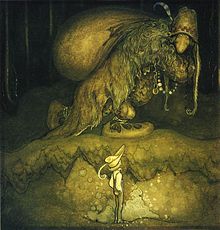
Analogy for The male child and the trolls by John Bauer, 1915
16–18th century [edit]
- Giuseppe Arcimboldo
- William Blake
- Hieronymus Bosch
- Brueghel
- Monsù Desiderio
- Henry Fuseli
- Hans Baldung Grien
- Matthias Grünewald
- Giovanni Battista Piranesi
19th century [edit]
- Arnold Böcklin
- William-Adolphe Bouguereau
- Gaston Bussiere
- Thomas Cole
- Walter Crane
- Richard Dadd
- Evelyn De Morgan
- Gustave Doré
- Caspar David Friedrich
- Francisco de Goya
- Edward Burne-Jones
- Max Klinger
- John Martin
- Gustave Moreau
- Albert Robida
- Viktor Vasnetsov
- Mikhail Vrubel
- John William Waterhouse
- George Frederic Watts
20th century [edit]
- John Bauer
- Abraham Mintchine
- Marc Chagall
- Giorgio de Chirico
- Salvador Dalí
- Jean Delville
- Paul Delvaux
- Max Ernst
- Hugh Ferriss
- Warwick Goble
- Thomas Häfner
- Alfred Kubin
- Maxfield Parrish
- Arthur Rackham
- Odilon Redon
- Nicholas Roerich
- Henri Rousseau
- Franz Sedlacek
- Yves Tanguy
- Clovis Trouille
Twentieth century [edit]
The ascent of fantasy and science fiction "pulp" magazines demanded artwork to illustrate stories and (via cover art) to promote sales. This led to a motion of science fiction and fantasy artists prior to and during the Great Depression, every bit anthologised past Vincent Di Fate, himself a prolific SF and infinite artist.[6]
In the Us in the 1930s, a group of Wisconsin artists inspired past the Surrealist motility of Europe created their own make of fantastic art. They included Madison, Wisconsin-based artists Marshall Glasier, Dudley Huppler and John Wilde; Karl Priebe of Milwaukee and Gertrude Abercrombie of Chicago. Their art combined macabre sense of humor, mystery and irony[7] which was in direct and pointed contradiction to the American Regionalism so in vogue.
In postwar Chicago, the fine art move Chicago Imagism produced many fantastic and grotesque paintings, which were petty noted because they did not conform to New York abstruse fine art fashions of the time. Major imagists include Roger Dark-brown, Gladys Nilsson, Jim Nutt, Ed Paschke, and Karl Wirsum.[viii]
Afterward 1970, modernistic western fantasy is influenced past illustrations from Conan the Barbaric and The Lord of the Rings,[nine] too as popular works of SF and fantasy like the role-playing game Advanced Dungeons & Dragons or the French Heavy Metal magazine.
Contemporary and mid-century artists [edit]

- Yoshitaka Amano
- Wayne Barlowe
- Zdzisław Beksiński
- Julie Bell
- Carlo Bocchio
- Arik Brauer
- Gerald Brom
- Clyde Caldwell
- Jeremy Caniglia
- Thomas Canty
- James C. Christensen
- Roger Dean
- Vincent Di Fate
- Gian Paolo Dulbecco
- Bob Eggleton
- Larry Elmore
- Ed Emshwiller
- Victoria Francés
- Frank Frazetta
- Brian Froud
- Wendy Froud
- Lisa Parker
- Ernst Fuchs
- Donato Giancola
- H.R. Giger
- Peter Gric
- Rebecca Guay
- James Gurney
- Rudolf Hausner
- Judson Huss
- Johfra
- Peter Andrew Jones
- Oleg A. Korolev
- Mati Klarwein
- Rodney Matthews
- Ted Nasmith
- Odd Nerdrum
- Terese Nielsen
- Max Magnus Norman
- John Jude Palencar
- Keith Parkinson
- Richard Thou. Powers
- Victoria Poyser
- Patrick J. Jones
- Donald Pass
- Bruce Pennington
- Álvaro Robles 1000.
- Antonio Roybal
- Luis Royo
- Marking Ryden
- De Es Schwertberger
- Wojciech Siudmak
- Anne Stokes
- Anne Sudworth
- Bridget Bate Tichenor
- Boris Vallejo
- Robert Venosa
- Michael Whelan
- Bernie Wrightson
- Jacek Yerka
- Jurgen Ziewe
Non-European art [edit]
Non-European art may contain fantastic elements, although information technology is not necessarily easy to separate them from religious elements involving supernatural beings and miraculous events.
Sculptor Bunleua Sulilat is a notable gimmicky Asian Fantastic artist.
See as well [edit]
- Dream fine art
- Outsider art
- Society for the Art of Imagination
- Surrealism
- Vienna School of Fantastic Realism
- Gruyères Castle
References [edit]
- ^ a b "Jahsonic, a vocabulary of culture". Archived from the original on 2005-11-16. Retrieved 4 August 2013.
- ^ a b c Schurian, Walter (2005) Beyond Mere Understanding. In: Fantastic Art, Schurian, W. & Grosenick, U. (Ed.), Taschen, p.6-25. ISBN 978-iii-8228-2954-7 (English edition)
- ^ "thinkexist.com". Archived from the original on 4 August 2013. Retrieved 4 Baronial 2013.
- ^ "From the Pre-Raphaelites to the Comics: Illustrating the Imaginative | Fantasy - BnF". fantasy.bnf.fr . Retrieved 2020-12-twenty .
- ^ Larkin, David, ed. (1973). Fantastic Fine art. Pan Ballantine.
- ^ Di Fato, Vincent. Infinite Worlds: The Fantastic Visions of Science Fiction Art.
- ^ Krajewski, Sara (1998). "Surreal Wisconsin: Surrealism and its Legacy of Wisconsin Fine art". aol.com. Madison Fine art Center. Archived from the original on 1999-12-05. Retrieved 2020-12-18 .
- ^ Richard Vine, "Where the Wild Things Were", Art in America, May 1997, pp. 98-111.
- ^ "The History of Fantasy Art & Fantasy Artists - The Art History Archive". www.arthistoryarchive.com . Retrieved 2020-12-18 .
Bibliography [edit]
- Coleman, A.D. (1977). The Grotesque in Photography. New York: Pinnacle, Ridge Press.
- Watney, Simon (1977). Fantastic Painters. London: Thames & Hudson.
- Colombo, Attilio (1979). Fantastic Photographs. London: Gordon Fraser.
- Johnson, Diana L. (1979). Fantastic analogy and design in United kingdom of great britain and northern ireland, 1850-1930. Rhode Isle School of Blueprint.
- Krichbaum, Jorg & Zondergeld. R.A. (Eds.) (1985). Lexicon of Fantastic Art. Barron's Educational Serial.
- Menton, Seymour (1983). Magic Realism Rediscovered 1918-1981. Philadelphia, The Art Alliance Printing.
- Day, Holliday T. & Sturges, Hollister (1989). Art of the Fantastic: Latin America, 1920-1987. Indianapolis: Indianapolis Museum of Art.
- Clair, Jean (1995). Lost Paradise: Symbolist Europe. Montreal: Montreal Museum of Fine Arts.
- Palumbo, Donald (Ed.) (1986). Eros in the Heed's Middle: Sexuality and the Fantastic in Art and Film (Contributions to the Study of Science Fiction and Fantasy). Greenwood Press.
- Stathatos, John (2001). A Vindication of Tlon: Photography and the Fantastic. Hellenic republic: Thessaloniki Museum of Photography
- Schurian, Prof. Dr. Walter (2005). Fantastic Art. Taschen. ISBN 978-3-8228-2954-vii (English edition)
- BeinArt commonage (2007). Metamorphosis. beinArt. ISBN 978-0-9803231-0-viii
- "El Canto de Abraxas" (2016) de Álvaro Robles G. (Editorial Salón Arcano) ISBN 978-987-42-2189-six
Source: https://en.wikipedia.org/wiki/Fantastic_art
0 Response to "Type of 2d Art That Is Based on Fantasy and the Supernatural"
Postar um comentário